JPMC Party Central Landing Page & SALT Modernization
Redesigning the entry point to a growing enterprise platform—improving orientation, task visibility, and access to critical workflows while helping Party Central begin its transition from Tuxedo to J.P. Morgan’s SALT design system.
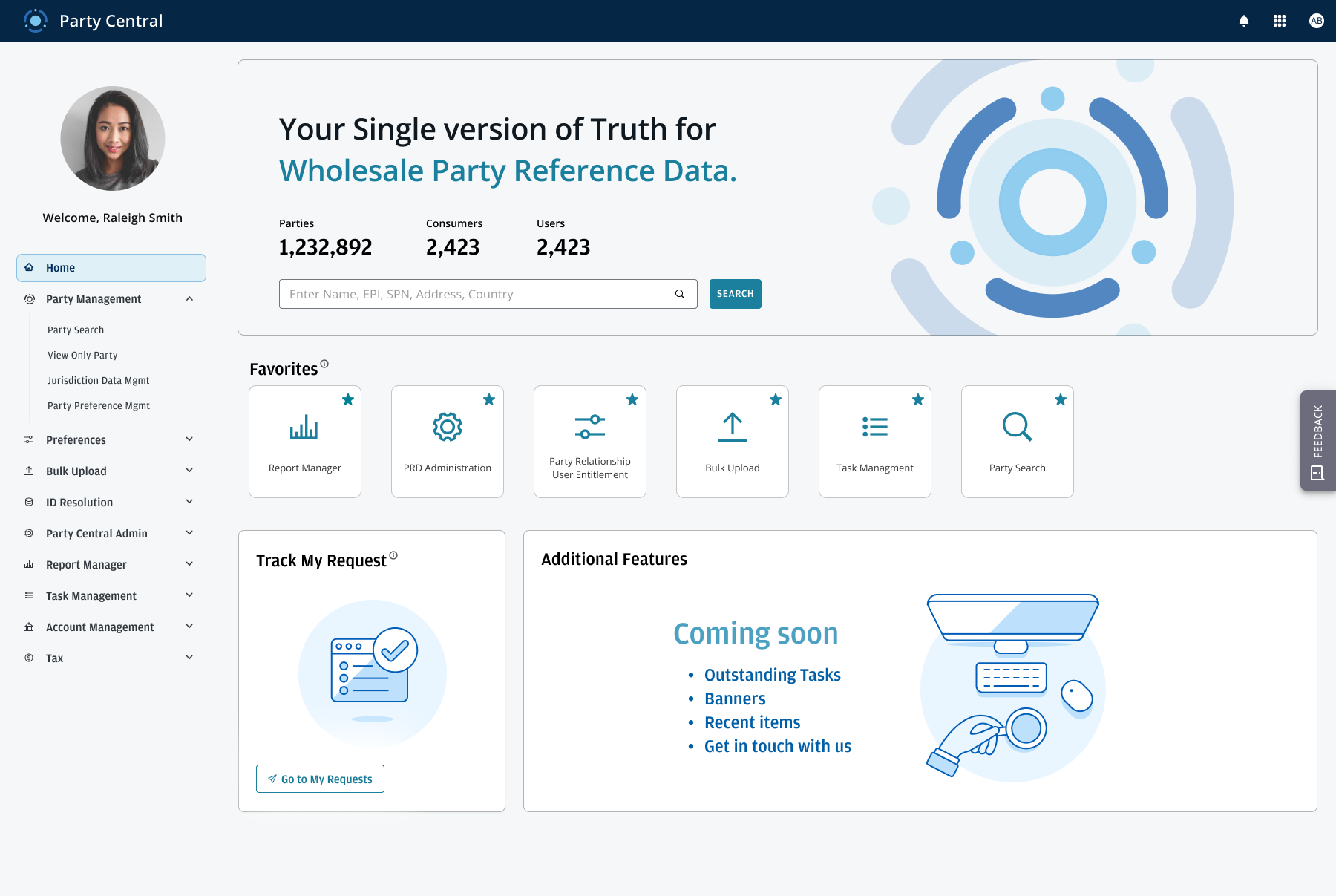
JPMC SALT-based concept bringing search, pending work, recent activity, and frequently used tools into one workspace.
Role
Senior UX Designer
Domain
Enterprise Systems · Platform UX · Information Architecture
Skills
User Research · Information Architecture · Dashboard UX · Platform Strategy · Cross-Squad Collaboration · Design Systems
Overview
Party Central had grown beyond what its landing page could support. Search, bulk upload, ID resolution, data maintenance, and other tools had been added over time, but the page still functioned largely as a flat application launcher.
Users often relied on bookmarks, familiarity, and tribal knowledge to find what they needed. The page provided little guidance about where to begin, what required attention, or how the applications related to one another.
I worked on a redesign that combined user interviews, information-architecture changes, feature prioritization, and early SALT component exploration. The project addressed immediate usability problems while giving the team a practical starting point for moving Party Central away from its legacy Tuxedo experience.
The Problem
As the platform grew, several issues became harder to ignore:
Applications and entry points lacked a clear hierarchy.
Related workflows were spread across independently owned tiles.
Tasks, updates, and status information were easy to miss.
Users depended on memorized locations and personal bookmarks.
Makers, checkers, and other operational users arrived with different priorities.
The existing Tuxedo interface limited how much the landing experience could evolve.
The page needed to do more than list applications. It needed to help users understand where they were, what needed attention, and where to go next.
My Role
I contributed UX strategy and design across the landing experience and related platform improvements.
My work included:
Interviewing Party Central users in different operational roles.
Reviewing the existing applications, navigation, and entry points.
Organizing a large set of proposed features into a clearer product direction.
Restructuring the information architecture around related workflows.
Exploring landing-page layouts based on user needs and product requirements.
Applying SALT components and patterns to early concepts.
Working with Product, Engineering, and partner squads on feasibility and sequencing.
Advocating for the landing-page effort to become Party Central’s first SALT-based experience.
Research & Insights
I interviewed everyday Party Central users, including dedicated makers and checkers, to understand how they entered the platform, found information, resumed work, and responded when a workflow failed.
The interviews reinforced several patterns:
Most users arrived with a specific task in mind.
Makers and checkers entered the platform with different priorities.
Users switched between search modes or used manual workarounds when results were unreliable.
Frequently used tools were not always easy to locate.
Users wanted faster access to pending tasks, recent activity, and work already in progress.
Clear feedback and reassurance mattered before users committed to an action.
The research suggested that the landing page should focus on orientation and task completion rather than becoming a large dashboard filled with every available metric.
Design Approach
1. Turning Requirements into a Shared Plan
A long list of ideas had accumulated around the landing experience, including search, portfolios, task summaries, banners, reports, product metrics, recent activity, and request tracking.
I organized these ideas into a concise summary that connected each proposed feature to a user or business benefit. The artifact helped Product and Technology partners understand the scope of the redesign and discuss priorities without getting lost in individual requirements.
2. Organizing Around User Intent
The redesign focused on the most common reasons users entered Party Central:
Find a party or record.
Resume recent or unfinished work.
Review pending tasks or approvals.
Open frequently used applications.
Enter bulk, maintenance, or administrative workflows.
This shifted the page away from browsing an application inventory and toward recognizable user goals.
3. Restructuring the Information Architecture
I grouped independently owned applications into clearer functional areas, including Party Management, Preferences, Bulk Upload, ID Resolution, Administration, Reporting, Task Management, Account Management, and Tax.
The revised structure:
Grouped related tools together.
Reduced dependence on memorized tile locations.
Replaced the flat application catalog with persistent navigation.
Used labels that better reflected how operational teams understood the work.
Allowed new tools to be added without continually expanding the homepage.
This became the bridge between the existing tile launcher and the proposed platform navigation.
4. Exploring the Landing Page as a Workspace
Early concepts tested how the landing page could support more than application access.
The explorations included:
Global search.
Favorites and frequently used tools.
Pending tasks.
Request tracking.
Recent activity.
Reports and product updates.
Content tailored to a user’s role or workflow.
I explored these as modular components rather than assuming every user needed every widget. That allowed the page to surface useful information without becoming unnecessarily dense.
The central questions were simple:
Where am I?
What needs my attention?
What should I do next?
5. Using SALT to Support the Transition
Party Central was still using the outgoing Tuxedo system. I advocated for the landing-page work to become the first Party Central experience built around SALT.
The SALT explorations introduced:
Shared navigation and interaction patterns.
Reusable cards, tables, banners, and task modules.
More consistent spacing and hierarchy.
Components that could support different roles and workflows.
A foundation that other Party Central initiatives could build on.
The intent was not to redesign the entire platform at once. The landing page offered a manageable place to introduce SALT while preserving access to familiar workflows.
6. Planning for Incremental Change
Party Central supported business-critical work, so the redesign could not depend on a sudden platform-wide replacement.
The proposed direction emphasized:
Familiar entry points.
Phased introduction of new features.
Reusable SALT patterns instead of one-off components.
Coordination with Search, Bulk Upload, ID Resolution, and other teams.
A structure that could evolve as more of the platform moved away from Tuxedo.
Solution
The redesigned landing page brought together:
Global party search.
Frequently used applications.
Pending tasks and approvals.
Request tracking.
Recent activity.
Reports and product communications.
Persistent navigation organized by function.
Reusable SALT components.
The result was a clearer entry point for daily work and a practical model for how Party Central could modernize over time.
Outcome
The work:
Gave users clearer starting points for common tasks.
Made related applications easier to locate.
Reduced dependence on a flat, memorized tile catalog.
Created a navigation model that could accommodate new capabilities.
Helped stakeholders align around a broad set of proposed changes.
Established a direction for Party Central’s move into SALT.
Produced patterns that could be reused in later platform work.
The requirements summary was particularly well received because it turned a complicated set of ideas into something Product and Technology partners could quickly understand and discuss.
Because this was an incremental platform effort rather than a single finished release, the strongest evidence of impact was clearer product direction, stakeholder alignment, and a reusable foundation for later work—not a single post-launch metric.
What I Learned
Direct user interviews exposed differences that the requirements alone did not capture.
Clear information architecture can make a collection of applications feel like one platform.
A landing page should reflect what users came to accomplish.
Design-system adoption works best when tied to a real product need.
Large enterprise platforms are often modernized through a series of credible, manageable changes.
Artifacts
Turning Requirements into a Shared Product Vision
Purpose: Make a broad set of proposed improvements easier for stakeholders to understand and prioritize.
I consolidated proposed features, supporting requirements, and intended benefits into a concise visual summary. The artifact was highly praised for making a complex initiative easier to digest and discuss across Product, Design, and Engineering.
Grounding the Landing Experience in Daily Work
Research focus: Understand how makers, checkers, and other Ops users searched, resumed work, and handled failure points.
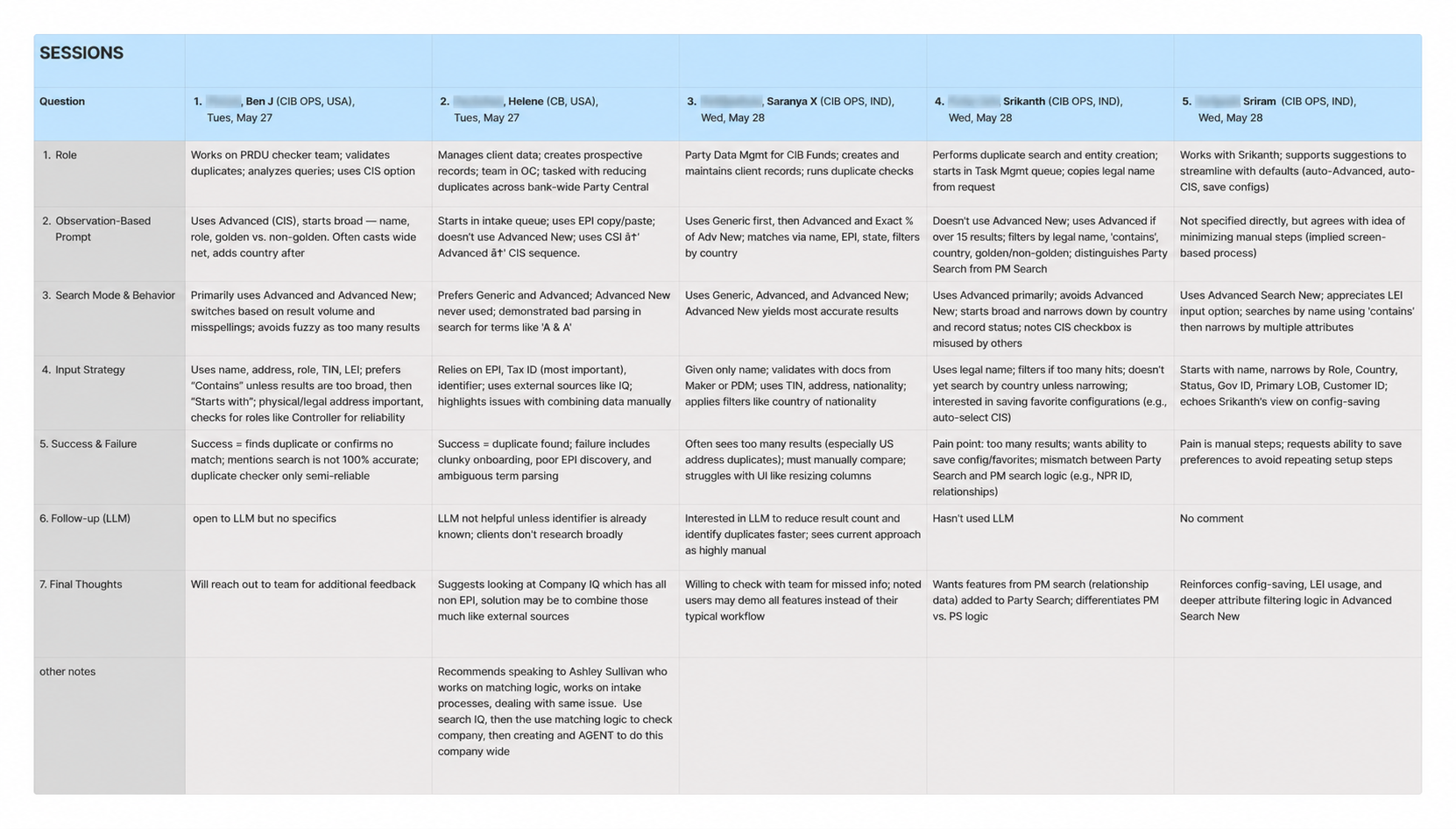
Interviews revealed differences in search behavior, input strategies, and daily priorities, while highlighting the need for quicker access to pending work, recent activity, and frequently used workflows.
From Disconnected Tiles to Coherent Navigation
IA objective: Group independently owned applications around recognizable operational functions.
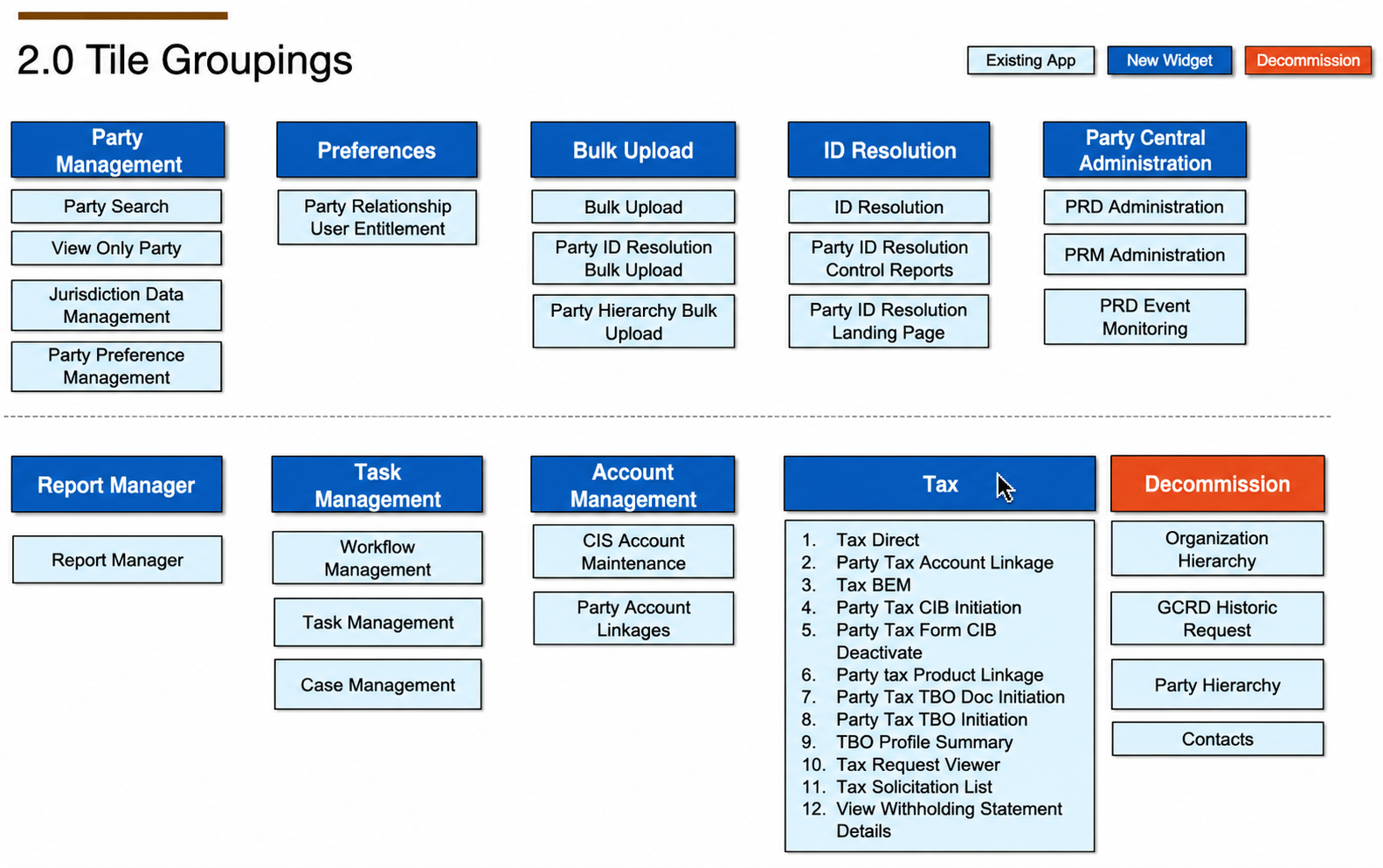
I reorganized the flat application catalog into clearer functional categories, creating the foundation for persistent navigation and reducing reliance on memorized tile locations.
Using the Landing Page to Lead Party Central into SALT
Early concepts: used JPMC’s forthcoming SALT components to demonstrate how shared navigation, reusable modules, and task-oriented dashboard patterns could support immediate needs while establishing a direction for future Party Central migrations.
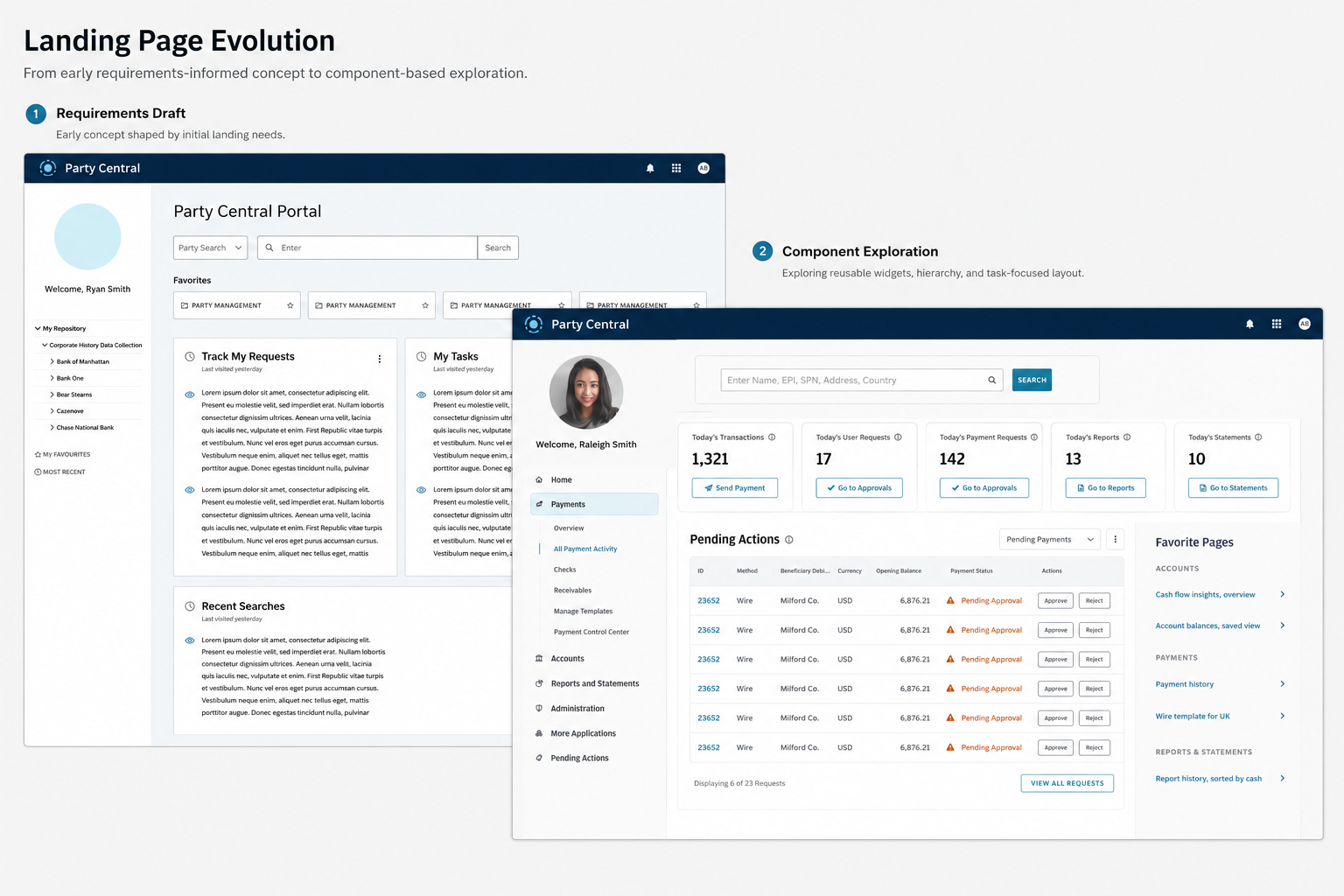
Early concepts used SALT components to demonstrate how shared navigation, reusable modules, and task-oriented dashboard patterns could support immediate needs while establishing a direction for future Party Central migrations.
From Application Catalog to User Workspace
Design objective: Reduce navigation friction by shifting from an application-centric launcher to a personalized, task-oriented experience.
Reimagined Party Central from a flat application launcher into a personalized workspace organized around users’ most common tasks. The redesign introduced persistent navigation, global search, favorites, and modular dashboard surfaces, creating a more intuitive experience and a scalable foundation for future capabilities.
